
Solar moratorium ended — responsible solar development returns to Montrose
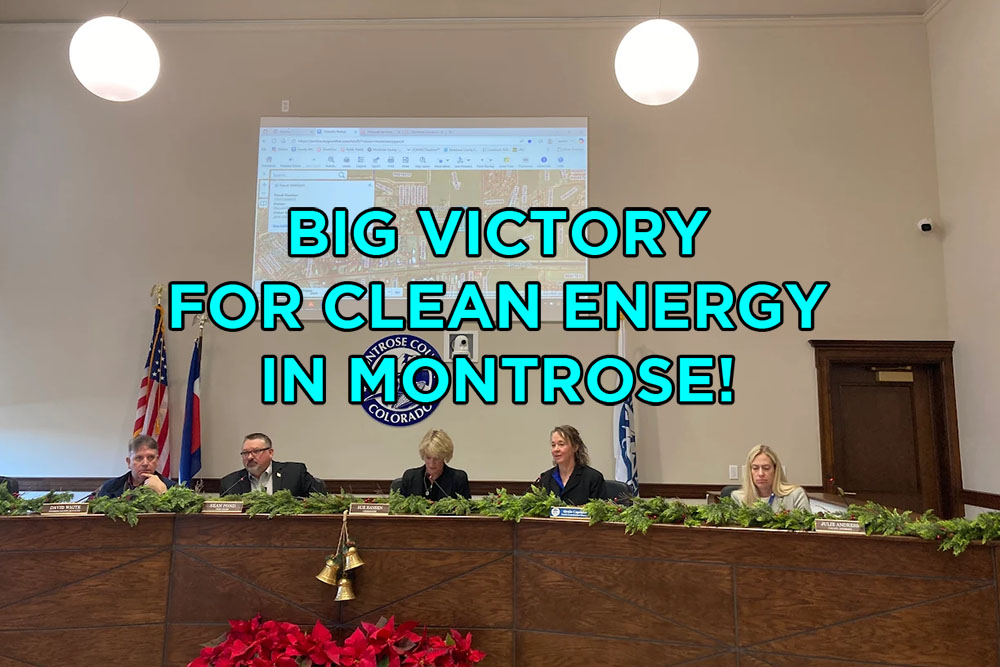
It’s official! The Montrose County solar moratorium has come to an end after three years of deliberation and public comment. The Board of County Commissioners voted today to approve a new land development code known as Alternative 1, which will allow responsible solar projects to be built once again. Our Alliance has been in this fight since day one, working closely with members of the community, farmers, land owners, solar developers, and industry experts to create a land use code that both reflected the concerns of Montrose residents and addressed the needs of a growing energy demand in Western Colorado. With just one small amendment — that all lights on site be faced downwards — Alternative 1 was approved in a 2-1 vote with Commissioners Hansen and Copeland in favor and Commissioner Pond voting opposed, stating as the reason that he wanted to see the plan he himself crafted (known as Alternative 2), or at least more parts from it, considered in the final vote.
Alternative 1 was crafted after the initial draft code was proposed in October 2024 when members of our Alliance attended meetings with the planning department, solar industry experts, and members of the community, both for and against solar, to create a thoughtful and balanced land use code. By November 2024, sitting commissioners were prepared to vote to approve it, but wanted to give deference to the two new commissioners-elect, Rick Dunlap and Scott Mijares, and instead passed the decision on to them. In February 2025, it appeared Alternative 1 was headed for approval until the sudden death of Commissioner Dunlap, which prompted a vacancy committee to fill his seat with Sean Pond, a West End resident and local firebrand who, with Mijares, made it their mission to ensure solar development would be impossible within the county.
After numerous delays in taking a vote on Alternative 1, and after claiming that, after 2.5 years, more community input was still needed, by August 2025, Commissioner Pond rolled out his own version of a code and gave residents just six days to review it before it was up for consideration. Solar industry experts had highlighted that Alternative 2 would have all but banned solar development in the county, and would have been one of the most, if not the most, restrictive solar codes anywhere in the state. Montrose Planning Committee members seemed to understand the severity of the proposed code when they reviewed Alternative 2 and failed to recommend it for consideration, much to the chagrin of Commissioner Pond. Despite that setback, Pond charged forward with his alternative code and hosted a series of town hall events in Nucla, Olathe, and Montrose in late October and early November in an attempt to drum up support for his alternative, but was met with overwhelming opposition by members of the community who continued to advocate for Alternative 1. This all culminated in a November 3 post on social media after the final town hall in Montrose, where Commissioner Pond admitted he had been out-organized by our Alliance, saying, “So yeah, they kicked your ass tonight.” On November 4, Montrose voters were faced with the question of whether or not to recall Commissioner Mijares, and by a 4% margin, voters determined he was not fit for office. He was replaced by Kirstin Copeland in late November, leaving Pond the sole supporter of Alternative 2 on the board.
Today’s vote proves what can happen when local leaders step up and, with incredible persistence and dogged determination, speak for what is right for their community. The passage of this land development code could not have been possible without the work of hundreds of Montrose County residents who sent letters to the commissioners, attended public meetings, wrote articles in the paper, and pounded the pavement to talk with their neighbors. The approval of Alternative 1 took three years to bring to fruition, but never once did our Alliance waver in our dedication to seeing it pass.
The road to progress is not always clear. It isn’t always short, but today’s passage of this solar code is evidence that, by working together, we can achieve great things for the communities we are a part of, care about, and love.


