

2026 Ballot Guide

Posted: October 16, 2026
Issues: Uncategorized
File Under: Featured
2026 Ballot Guide Logo

Colorado is facing one of the most complex ballots we have ever had, and we are here to help you understand the many different amendments and propositions you have a chance to vote on in 2026. On this page, you will find a simplified explanation of each measure, a bit about what proponents and opponents of each measure have to say, and the position our Alliance has taken on each. We encourage every voter to weigh the information and make their own decision. By clicking the links above, you can view some of the local ballot measures in Mesa, Montrose, or Garfield counties, and how our local affiliate groups feel about them. You can also download our House Party Guide to learn how to share this great information with your friends and neighbors and get access to our physical Ballot Guide, which you can provide to anyone you know who may have questions about this year’s long and confusing ballot.

AMENDMENT 87 - Graduated Income Tax
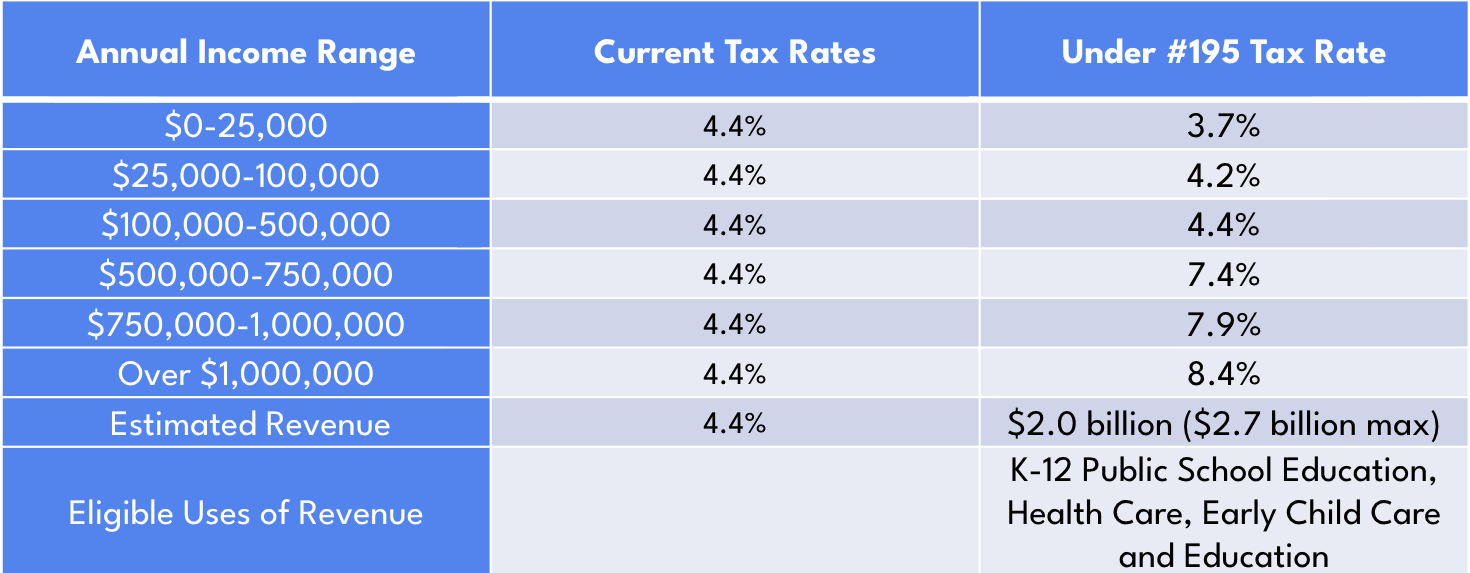
Colorado’s Amendment 87 would replace the state’s current flat 4.4% income-tax rate with a graduated system, meaning the tax rate would increase as income rises. In general, it would lower the average state income tax for households earning below $1 million, while significantly increasing taxes on higher-income households, particularly those earning more than $1 million. The measure is projected to raise about $2.7 billion annually, with the new revenue dedicated to K–12 education, health care, and early-childhood education, and it would change TABOR so this new revenue could be retained and spent by the state.
A spreadsheet chart showing how a GIT will affect different taxpayers

Supporters say:

Proponents argue this measure would give a tax cut to most Coloradans (97%) while asking the highest earners to contribute more, and would lower taxes for the vast majority of small businesses, only impacting approximately the top 15% of businesses across the state. 26 other states already have a graduated income tax system, and higher earners and businesses have not fled those states. Colorado has faced budget pressures, and the additional revenue can protect schools, healthcare, and other public services we critically need.

Opponents say:

Opponents argue that the headline “tax cut for most people” obscures a substantial increase on higher earners, which they say could discourage investment, hurt small businesses, and cause wealthy residents to leave Colorado. They also criticize the measure because its tax brackets aren’t automatically adjusted for inflation, arguing that more people could gradually move into higher brackets over time even without becoming richer in real terms.

Our Alliance's position:

We encourage voters to vote YES on Amendment 87 Graduated Income Tax. Colorado desperately needs a change to our tax system to be more fair, where lower earners pay less and higher earners pay more, and this additional revenue to support education, health care, and child care is needed to ensure our state can prosper.
A green checkmark

Proposition NN - TABOR Revenue Cap Increase for K-12 Education

Proposition NN is a measure seeking to change Colorado’s TABOR revenue limit and K–12 education funding. If approved, it would allow the state to retain and spend money that otherwise would have to be refunded to taxpayers under TABOR, rather than returning that excess revenue to taxpayers. The measure would use the retained money to increase K–12 education funding by up to 2% per year for 10 years, with additional money potentially going toward disability services, school services, child care, and preschool. It would therefore not create a new tax or increase existing tax rates; instead, it changes how excess revenue is handled under TABOR. The measure was referred to voters by the legislature through SB26-135.

Supporters say:

Proponents argue that Colorado has chronically underfunded K–12 schools and that Proposition NN would provide a long-term, predictable source of additional funding without raising tax rates. They say the money could help increase teacher pay and retention, reduce class sizes, and expand career and technical education. Supporters also emphasize that the measure includes annual independent audits and say Colorado is investing revenue it already collects rather than imposing a new tax.

Opponents say:

Opponents argue that the measure effectively reduces or eliminates future TABOR refunds and gives state lawmakers substantially more control over revenue. They point out that while the measure specifically directs money toward K–12 education, the increase to the TABOR limit is permanent, and they argue that this could allow the state to retain significantly more revenue than the amount ultimately spent on schools.

Our Alliance's position:

We encourage voters to vote YES on Proposition NN. Colorado, despite having the highest educated population in the country, has among the worst funded K-12 schools. TABOR’s revenue limit has made it impossible to properly or adequately fund our schools, and this measure would do so without raising taxes on anyone.
A green checkmark

AMENDMENT 81 - Notification of DHS for Certain Criminal Charges and Immigration Status

Amendment 81 would amend the state constitution to require state and local law enforcement agencies to notify the U.S. Department of Homeland Security when someone is arrested or charged with certain crimes (such as if a person is charged with a violent crime or has previously been convicted of a felony) and the agency determines the person is not lawfully present in the United States. It would also require law enforcement to provide certain information to federal immigration authorities and would establish related cooperation and reporting requirements. The measure is intended to increase coordination between Colorado law enforcement and federal immigration authorities. Because it changes the Colorado Constitution, it requires 55% voter approval to pass.

Supporters say:

Proponents, led by Advance Colorado, say the measure is about public safety and cooperation with federal immigration authorities. They argue that if someone who is unlawfully present — or whose status cannot be determined — is charged with a violent crime or has a prior felony, local law enforcement should be required to notify federal immigration officials rather than being prevented from sharing that information. They also argue that Colorado’s current restrictions go too far because they can discourage cooperation even in cases involving serious or repeat offenders.

Opponents say:

Opponents, including groups such as Rocky Mountain Equality and the Bell Policy Center, argue that the measure would turn local police into participants in federal immigration enforcement and could undermine trust between immigrant communities and law enforcement. They particularly object to notification based on a charge rather than a conviction, arguing that someone could be reported to federal immigration authorities before their case has been resolved in court. They also argue that increased cooperation with ICE could make people less willing to report crimes or interact with police.

Our Alliance's position:

We encourage voters to vote NO on Amendment 81. We believe theat local law enforcement should focus on local law enforcement, and not be pulled into federal law enforcement which is the job of the Department of Homeland Security. This would destroy trust between law enforcement and local communities and increase the chances of serious crimes not being reported. We should not turn local police into federal agents.
A Red X

AMENDMENT 82 - Colorado Right to Purchase & Sell Natural Gas for Cooking & Heating

Amendment 82 would add a constitutional right for customers — both homeowners and businesses — to purchase natural gas for cooking or heating, while also giving natural-gas distributors and utilities the right to sell it. In practical terms, the amendment is intended to prevent the state or local governments from banning or prohibiting consumers from choosing natural gas for these uses. It would make that right part of the Colorado Constitution, meaning changing it later would require another constitutional amendment. The measure requires 55% approval to pass.

Supporters say:

Proponents say the amendment protects consumer choice by guaranteeing Colorado households and businesses the ability to purchase natural gas for cooking and heating. They argue that consumers should be able to choose the energy source that works best for them, and that restricting natural-gas availability could raise costs or reduce reliable energy options. Supporters also say putting the right in the Constitution protects it from future state or local policies that might restrict natural-gas sales.

Opponents say:

Opponents argue that the amendment is unnecessary because Colorado residents can already legally buy natural gas, and there is no current statewide proposal to prohibit its sale. They contend that putting a right to natural gas in the Constitution could make it harder for Colorado or local governments to pursue policies aimed at reducing greenhouse gas emissions and transitioning buildings toward lower carbon energy sources. They also argue that the measure could constrain future energy policy and potentially interfere with existing or future climate regulations.

Our Alliance's position:

We encourage voters to vote NO on Amendment 82 Colorado Right to Purchase and Sell Natural Gas for Heating and Cooking. To put it simply, this does not belong in the Constitution, and the ability to use natural gas is not prohibited nor has anyone suggested it be at the legislature. This is unnecessary and prohibits our state from moving nimbly as the energy environment changes.
A Red X

PROPOSITION 136 - Colorado Cap Individual & Business Income Tax at 4.4%

Proposition 136 would change the state’s income-tax rules by setting a maximum state individual income-tax rate of 4.4% and limiting the legislature’s ability to increase that rate without voter approval. It would preserve Colorado’s current flat income-tax rate as a constitutional/statutory limit and require voters to approve future increases above the limit. Proposition 136 is a statutory measure, so it requires a simple majority to pass. It is separate from Amendment 87, which would create a graduated income-tax system, and should both pass the one with the most votes would go into effect.

Supporters say:

Proponents — including Advance Colorado — say the measure would protect Colorado taxpayers and businesses from higher income tax rates by capping both individual and corporate income taxes at the current 4.4% rate. They argue that keeping taxes low helps Colorado remain competitive, prevents people and businesses from leaving the state, and protects the principles behind TABOR.

Opponents say:

Opponents argue that the measure would prevent Colorado from adopting a graduated income tax system and therefore limit the state’s ability to raise additional revenue from higher income taxpayers. Their competing proposal, Amendment 87, would lower rates for lower income taxpayers while increasing rates on higher income earners, with the additional revenue directed toward education, health care, and child care. Supporters of that approach argue that Colorado needs additional revenue for those services and that the current flat rate places too much of the tax burden on lower- and middle-income residents.

Our Alliance's position:

We encourage voters to vote NO on Proposition 136. We believe that the current rate and flat tax system place too much of the tax burden on low and middle income Coloradans, and a graduated income tax makes much more sense for the Colorado of today. Colorado is one of the most competitive economies in the country and with a graduated income tax that will not change, nor will high income residents or large businesses flee the state as opponents suggest.
A Red X

PROPOSITION 135 - Prohibit Surgeries for Treatment in Response to Minor's Perception of Sex or Gender

Proposition 135 would prohibit health care professionals from knowingly performing surgery on a person under 18 for the purpose of altering the person’s biological sex or treating gender dysphoria/gender incongruence. The measure specifically targets surgical procedures; it does not ban puberty blockers or hormone treatments. It would make performing the prohibited surgery a civil offense and allow the state to take action against a professional’s license.

Supporters say:

Proponents argue that minors should not undergo irreversible surgical procedures related to gender transition, saying the law would protect children from decisions they believe they may later regret. The measure’s proponents have framed it as a child protection issue and argue that parents and doctors should not be able to authorize these particular surgeries for minors.

Opponents say:

Opponents, including Rocky Mountain Equality, argue that the measure would improperly interfere with medical decisions made by families, patients, and health-care providers. They characterize the initiative as part of a broader effort to restrict gender-affirming care for transgender youth and argue that government should not prohibit doctors from providing medically appropriate care.

Our Alliance's position:

We encourage voters to vote NO on Proposition 135. We believe health care decisions belong between individuals, their families, and their doctors, and that government should have no role in personal health care decision-making. Punishing doctors with the legal system for providing medically appropriate care and dictating personal decision making is not who we as Coloradans are.
A Red X

PROPOSITION 134 - Sex Requirement for School and College Sport

Proposition 134 would establish rules for participation by male and female students in school and collegiate sports, generally requiring athletic teams to be separated by biological sex and limiting participation in women’s and girls’ sports to students who are biologically female. The measure would apply to public schools, colleges, and universities, as well as certain private institutions that participate in public-school or intercollegiate athletic programs. It would also create a process for resolving disputes over eligibility.

Supporters say:

Proponents, including Protect Kids Colorado and the Colorado Catholic Conference, argue that athletic competition should be separated by biological sex because they say physical differences such as muscle mass, bone density, and strength can create competitive and safety advantages for males competing against females; they describe the measure as protecting girls’ athletic opportunities.

Opponents say:

Opponents, including One Colorado and Families Not Politics, argue that the measure would exclude transgender students from participating on teams consistent with their gender identity and could increase stigma and discrimination. They also raise concerns about how the rule would actually be enforced — particularly who would determine a student’s sex and whether students could face intrusive scrutiny.

Our Alliance's position:

We encourage voters to vote NO on Proposition 134. We do not support measures that seek to stigmatize or isolate children, and this measure is poorly written and poorly thought through as there is no plan for determination of a student’s sex, leaving the door open to coaches or other school administrative figures checking children’s genitalia which is inappropriate and wrong.
A Red X

PROPOSITION 132 - Penalties for Fentanyl Sale and Possession

Proposition 132 would increase criminal penalties for fentanyl-related offenses. In simple terms, it would make the distribution, manufacturing, dispensing, sale, or possession of any amount of fentanyl subject to more serious felony penalties, with some offenses carrying mandatory prison terms; possession would generally become a Level 4 drug felony with court-ordered treatment, with more serious charges possible depending on the amount involved. It would also change Colorado’s rules for habitual criminal sentencing and narrow certain protections for people who report an overdose after distributing a drug.

Supporters say:

Proponents — including Advance Colorado, law-enforcement groups, and some district attorneys — argue that fentanyl is unusually dangerous and that stronger penalties are needed to deter people from manufacturing, selling, and distributing it. They say holding dealers and traffickers more accountable could reduce fentanyl use and overdoses, while court-ordered treatment for people convicted of possession could help address addiction.

Opponents say:

Opponents — including the Colorado Criminal Justice Reform Coalition and other criminal-justice and public-health organizations — argue that mandatory prison sentences are unlikely to reduce fentanyl use and could actually make the overdose crisis worse by disrupting treatment and increasing incarceration. They also object to the possibility of very long sentences for relatively low-level conduct, including sharing a pill, and point out that someone could face severe penalties even if they did not know fentanyl was present.

Our Alliance's position:

Our Alliance did not take a position on this measure and is therefore neutral.
A yellow horizontal line

PROPOSITION 133 - Require Life in Prison for Human Trafficking of Minors

Proposition 133 would dramatically increase the penalty for human trafficking of a child for sexual servitude. Under the measure, a person convicted of trafficking a minor for that purpose would face life imprisonment without the possibility of parole or release, rather than the penalties available under current law. In simple terms, it would make this specific form of child sex trafficking punishable by life without parole.

Supporters say:

Proponents, including Protect Kids Colorado and the Colorado Catholic Conference, argue that trafficking children for commercial sexual activity is so serious that offenders should receive the maximum possible punishment. They say a mandatory life sentence would both ensure that convicted traffickers cannot later be released and potentially deter people from committing these crimes.

Opponents say:

Opponents’ arguments focus primarily on mandatory sentencing and the possibility of prosecuting trafficking survivors themselves. They argue judges should retain discretion to consider the individual circumstances of each case rather than imposing life without parole automatically. They also warn that trafficking victims can sometimes be coerced into recruiting or trafficking other victims, and that the measure could result in extremely harsh sentences for those survivors.

Our Alliance's position:

Our Alliance did not take a position on this measure and is therefore neutral.
A yellow horizontal line

PROPOSITION 137 - Retain Sporting Goods Sales Tax Revenue for Conservation & Wildfire Prevention

Proposition 137 would change how the state handles the sales tax revenue generated from sporting goods and outdoor recreation equipment. Currently, because of TABOR, some of that revenue can be refunded to taxpayers when collections exceed the state’s limits; Proposition 137 would allow the state to keep that excess revenue and dedicate it to conservation and outdoor-related projects instead. The money would support things such as wildfire mitigation, water and river protection, land conservation, wildlife habitat, state parks, and outdoor recreation, with roughly $175 million per year expected to be available. Importantly, it would not increase the existing sales tax rate; it changes where excess revenue goes.

Supporters say:

Proponents argue that Colorado has significant needs for wildfire prevention, water conservation, land and wildlife protection, parks, and outdoor recreation, and that Proposition 137 provides a dedicated funding source without increasing the sales tax rate or the price of sporting goods. They say the money would support programs such as wildfire mitigation, water projects, conservation, outdoor access, and recreation-related economic development.

Opponents say:

Opponents argue that the measure is fundamentally a change to TABOR, because it would allow the state to retain revenue that otherwise could be subject to TABOR restrictions and potentially refunded. Their concern is that voters would be giving up future taxpayer refunds in exchange for dedicating that money to specific government programs. They also question whether putting this revenue outside the normal TABOR framework gives the state too much spending flexibility in the future.

Our Alliance's position:

We encourage voters to vote YES on Proposition 137 Retain Sporting Goods Sales Tax Revenue for Conservation and Wildfire Prevention. Our board believes this measure would fund many important programs that would support conservation and prevent wildfires that have been a yearly and worsening problem for our communities. Our board recognizes concerns from opponents about this proposition, particularly the concern that it would open the door to commercial logging being utilized as a main means of wildfire prevention, however we believe that the agencies charged with implementing these funds are acting in good faith and do not currently support road construction or major commercial logging, and that these funds would support important urban/rural interface wildfire mitigation programs.

A yellow horizontal line

AMENDMENT 83 - Colorado Right to Hunt and Fish

Amendment 83 would add a constitutional right to hunt, fish, and take wildlife through traditional methods. It would also declare that hunting and fishing are the state’s preferred methods for responsibly managing fish and wildlife populations. The amendment would not allow hunting endangered species, species protected by federal law, or trespassing on private property, and it would preserve the state’s ability to regulate hunting and fishing. In simple terms, it would give hunting and fishing a protected place in the Colorado Constitution while leaving existing wildlife regulations largely in place. Because it is a constitutional amendment, it requires 55% voter approval to pass.

Supporters say:

Proponents argue that hunting and fishing are important parts of Colorado’s heritage and should receive constitutional protection from future efforts to restrict or eliminate them. They also argue that hunting and fishing are important tools for managing wildlife populations and want to protect them from anti-hunting initiatives or regulatory changes.

Opponents say:

Opponents argue that putting the right into the Constitution could make it harder for Colorado Parks and Wildlife, lawmakers, and voters to respond to changing wildlife conditions. A particular concern is the phrase “traditional methods,” which the amendment doesn’t define; opponents say that ambiguity could lead to lawsuits over whether currently prohibited practices are constitutionally protected and could bring back methods such as leg traps and bear-baiting. They also object to making hunting and fishing the state’s “preferred” methods of wildlife management, arguing that conservation sometimes requires other approaches, such as habitat restoration, relocation, disease prevention, population restrictions, or nonlethal methods.

Our Alliance's position:

Our Alliance did not take a position on this measure and is therefore neutral.
A yellow horizontal line

AMENDMENT 84 - Require Voter Identification Number for Mail-In Ballots Initiative

Amendment 84 would change the state Constitution to require voters who cast a mail-in ballot to provide both their signature and an additional identification number — such as the last four digits of their Social Security number or a Colorado REAL ID number. Election officials would compare that information with the statewide voter-registration database; if there is a discrepancy, the voter would be notified and would have an opportunity to correct it before the ballot could be counted. In simple terms, it would add an ID-number verification step to Colorado’s existing mail-ballot signature requirement, with the stated goal of strengthening ballot verification. It is a constitutional amendment, so it requires 55% voter approval.

Supporters say:

Proponents argue that requiring voters to provide an additional identifier — such as the last four digits of a Social Security number or a Colorado driver’s-license/ID number — would add another layer of identity verification and help ensure that people are submitting ballots belonging to them. Supporters point out that voters would still have an opportunity to correct (“cure”) a discrepancy before their ballot is rejected.

Opponents say:

Opponents argue that Colorado’s existing system already verifies mail ballots through signature matching, and they say the additional requirement is unnecessary. Their concern is that requiring another piece of information could create more opportunities for ballots to be rejected or voters to make mistakes, potentially making voting harder for some eligible voters.

Our Alliance's position:

Our Alliance did not take a position on this measure and is therefore neutral.
A yellow horizontal line

AMENDMENT 85 - Require Plain Language & 8th-Grade Reading Level for Ballot Measures Initiative

Amendment 85 would amend the state Constitution to require statewide ballot questions to be written in plain, understandable language, generally at no higher than an eighth-grade reading level. The measure is intended to make it easier for voters to understand what they are actually being asked to approve or reject, rather than relying on highly technical or legalistic wording. It would also prevent the legislature from overriding the plain-language requirement by requiring particular wording in ballot questions. Amendment 85 is a constitutional amendment, so it requires 55% approval to pass.

Supporters say:

Proponents argue that ballot questions can involve complicated legal and policy issues, so voters should be able to understand them without having to decipher technical language. They say requiring plain language at no higher than an eighth-grade reading level would make the ballot more accessible and help voters understand what a “yes” or “no” vote actually does. The measure is supported by Advance Colorado.

Opponents say:

Opponents argue that simplicity can come at the expense of important information. The Bell Policy Center, for example, says the measure could prevent ballot questions from including provisions that explain the financial effects of tax changes on voters and state and local budgets. Critics also question whether an eighth-grade readability standard is an appropriate way to handle inherently complex legislation and whether this issue belongs in the Constitution.

Our Alliance's position:

Our Alliance did not take a position on this measure and is therefore neutral.
A yellow horizontal line

AMENDMENT 86 - Require Congressional Maps to be Approved by Both a Nonpolitical Commission & the Colorado Supreme Court Amendment

Amendment 86 would change the rules for mid-decade (off-cycle) congressional redistricting. It would require any such redistricting map to be approved by both Colorado’s independent redistricting commission and the Colorado Supreme Court, and it would prohibit approval of a map that was intentionally drawn to favor one political party. In simple terms, the amendment is designed to make it harder for either political party to redraw Colorado’s congressional districts for partisan advantage between regular redistricting cycles. It would amend the state Constitution, so it requires 55% voter approval to pass.

Supporters say:

Proponents argue that congressional districts should not be redrawn in the middle of the decade simply because political circumstances change. They say Amendment 86 would protect Colorado’s independent redistricting process, prevent maps from being intentionally designed to benefit one party, and give voters more stable representation. Supporters, including Advance Colorado, specifically describe the measure as a safeguard against partisan gerrymandering.

Opponents say:

Opponents argue that the amendment could tie Colorado’s hands if other states redraw their congressional maps for partisan advantage. Their concern is that Colorado might need the ability to respond to major changes in national redistricting rather than being constitutionally prevented from changing its own districts mid-decade. There is also a broader argument that congressional redistricting is a national political issue, so unilaterally restricting Colorado could leave the state unable to respond to actions elsewhere.

Our Alliance's position:

Our Alliance did not take a position on this measure and is therefore neutral.
A yellow horizontal line